
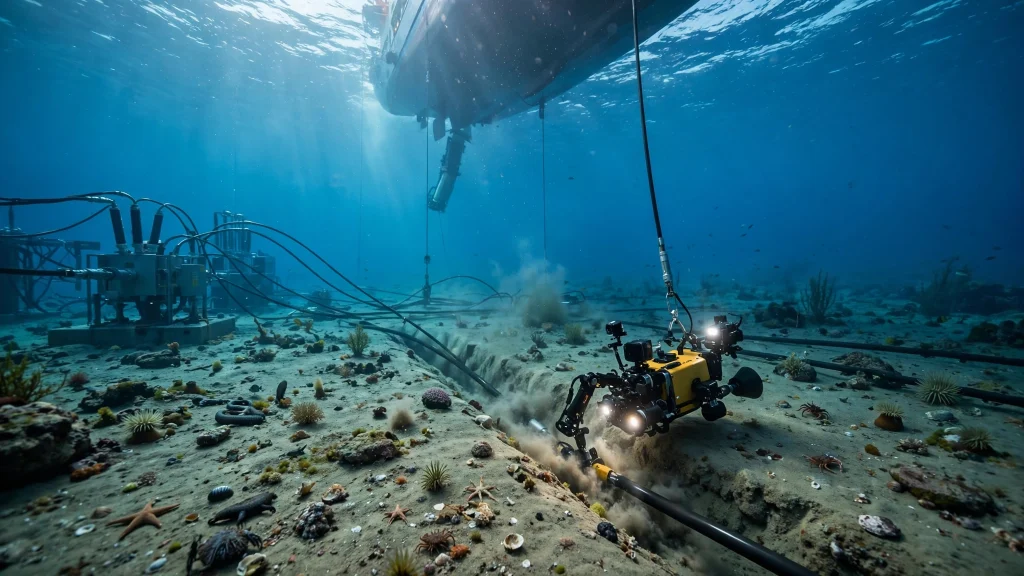
Underwater Cable Installation is the foundation of today’s connected world. More than 95% of international internet traffic travels through subsea fiber-optic cables rather than satellites. These networks also support offshore energy projects, defense systems, and global financial transactions. As digital demand grows, reliable submarine infrastructure has become a strategic priority for governments and private industries.
Modern economies depend on secure communication, uninterrupted power transmission, and efficient offshore operations. Underwater Cable Installation connects continents, links offshore wind farms, and strengthens national infrastructure resilience. Every installation project requires advanced engineering, environmental planning, and specialized vessels to ensure long-term performance in some of the world’s most challenging marine environments.
Why Underwater Cable Installation Is Essential for Modern Infrastructure
The Backbone of Global Connectivity
Underwater Cable Installation enables the transfer of enormous volumes of data across oceans with exceptional speed and reliability. Fiber-optic submarine cables carry cloud computing traffic, international banking transactions, streaming services, and enterprise communications. Industry analysts estimate that hundreds of active submarine cable systems now connect every major continent, supporting billions of internet users every day.
Unlike satellite communication, subsea fiber networks provide lower latency and significantly greater bandwidth. These advantages improve video conferencing, online gaming, cloud storage, and financial trading. Governments and multinational organizations continue investing in new cable systems because digital infrastructure has become as important as roads, ports, and airports.
Key Benefits
- Supports global internet connectivity.
- Enables secure international communications.
- Reduces latency compared to satellite networks.
- Increases network reliability through redundant routes.
- Supports expanding cloud computing services.
- Strengthens digital economic growth.
Supporting Offshore Energy Infrastructure
Connecting Renewable and Conventional Energy
Underwater Cable Installation plays a critical role in offshore energy development. High-voltage submarine power cables connect offshore wind farms, oil platforms, and offshore substations with onshore electrical grids. These systems allow renewable energy generated at sea to reach homes and businesses efficiently.
The global expansion of offshore wind projects has significantly increased demand for submarine power cables. Engineers carefully select cable routes that minimize environmental impact while maximizing operational safety. Specialized installation vessels bury cables beneath the seabed, protecting them from anchors, fishing equipment, and harsh ocean conditions.
Common Energy Applications
| Infrastructure Type | Purpose | Benefit |
|---|---|---|
| Offshore wind farms | Power transmission | Clean energy delivery |
| Oil and gas platforms | Electrical supply | Reliable offshore operations |
| Interconnector cables | Grid connection | Cross-border energy exchange |
| Offshore substations | Power distribution | Improved grid stability |
Engineering Challenges Behind Underwater Cable Installation
Advanced Planning and Marine Surveying
Every Underwater Cable Installation project begins with extensive planning. Engineers perform detailed seabed surveys using remotely operated vehicles, sonar mapping, and geophysical analysis. These studies identify rock formations, underwater slopes, existing pipelines, and environmentally sensitive habitats before installation begins.
Accurate route planning reduces installation risks and lowers long-term maintenance costs. Marine engineers also evaluate ocean currents, sediment conditions, seismic activity, and weather patterns. This information helps determine the safest cable path while ensuring compliance with national and international regulations.
Installation Technology
Modern installation vessels use dynamic positioning systems that maintain precise locations without anchoring. Specialized equipment lays cables on or beneath the seabed with remarkable accuracy. In shallow waters, trenching machines or cable plows bury cables to improve protection against external damage.
Continuous monitoring during installation ensures proper cable tension and placement. Engineers collect real-time operational data that supports quality assurance and verifies compliance with project specifications.
Protecting Critical Infrastructure Through Reliable Cable Networks
Improving Security and Operational Resilience
Underwater Cable Installation strengthens critical infrastructure by creating secure communication and power networks. Governments increasingly recognize submarine cables as strategic national assets because they support defense communications, emergency services, healthcare systems, and financial institutions.
Network redundancy further improves resilience. Multiple cable routes reduce service disruptions if one cable experiences accidental damage. This approach allows internet providers and utility operators to maintain essential services during maintenance or unexpected incidents.
Risk Management Measures
Several protective strategies improve long-term cable performance:
- Continuous cable monitoring systems.
- Seabed burial in high-risk areas.
- Regular marine inspections.
- Route diversification.
- Predictive maintenance programs.
- International infrastructure cooperation.
These measures reduce operational risks while extending infrastructure lifespan and minimizing costly repairs.
Environmental Responsibility in Underwater Cable Installation
Balancing Development and Marine Conservation
Environmental protection remains an important part of every Underwater Cable Installation project. Developers conduct environmental impact assessments before construction begins. These studies evaluate marine ecosystems, coral reefs, fish migration routes, and protected habitats.
Modern installation techniques minimize seabed disturbance through careful route selection and precision equipment. Many projects schedule construction outside sensitive breeding or migration seasons to reduce ecological impacts. Environmental monitoring continues after installation to verify successful habitat recovery where temporary disturbances occurred.
Industry Best Practices
Leading engineering firms follow internationally recognized environmental standards throughout planning, installation, and maintenance. Collaboration with marine scientists, regulators, and local communities improves project outcomes while supporting sustainable ocean resource management. These practices demonstrate that technological advancement and environmental responsibility can successfully coexist. Explore our latest insights in How Chemical Injection Repairs Concrete Cracks and Water Leaks.
Conclusion
Underwater Cable Installation supports global communications, renewable energy, and national resilience through highly reliable submarine infrastructure. Careful engineering, advanced technology, and responsible environmental management ensure these systems operate for decades. As digital services and clean energy continue expanding, submarine cable networks will remain essential components of critical infrastructure worldwide.